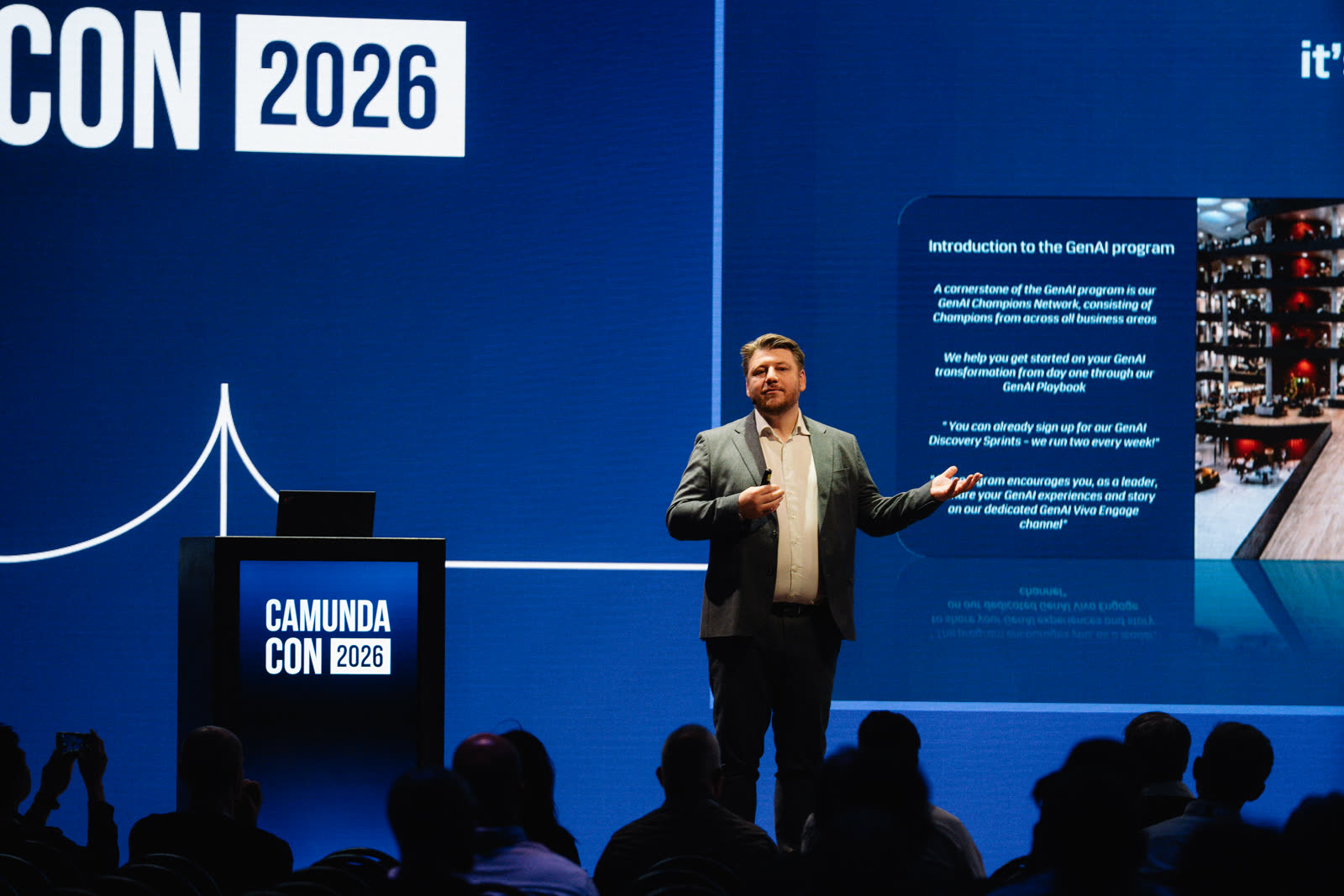
A talk on GenAI adoption and the 10/20/70 principle, CamundaCon 2026.
Analyses and notes
Adoption has outrun trust
Rillion's Nordic Finance AI Report 2026 surveyed 250 finance leaders in Denmark, Sweden and Finland. 8 in 10 already use AI, but only 1 in 5 trust it when the decision really counts. The biggest barrier is not technology, security or budget. It is knowledge: 1 in 4 CFOs point to a lack of internal AI competence. The will is there, the competence is not.
Read the post on LinkedIn →95% of AI pilots fail. Here is why.
It is rarely the model that is the problem. MIT NANDA's study "The GenAI Divide" shows that almost all enterprise pilots strand without effect on the bottom line. Not because of resistance, but because no one has taken responsibility for the way forward: neither ownership, structure nor a plan for operations.
10/20/70: where the AI investment is decided
BCG's principle for digital transformations: 10% is about algorithms, 20% about technology and data, and 70% about people and processes. Most budgets are allocated in the opposite order. That is where the gap between investment and effect appears.
Technology that isn't used is just technology
At a workshop during the Nordic Scholarship Exchange, each of us wrote the competencies we could offer the group. I wrote "Helping people & AI fall in love". When I came back, colleagues had covered the poster with notes: "People ♥ AI". Use starts with people.
Read the post on LinkedIn →We invest in AI, but not in people
Huge sums are going into AI technology right now: licences, platforms, tools. But the technology on its own moves nothing. The people who have to use it do. What worked for us was not a rollout, but a culture: hands-on with people's own tasks, a local champion network, and aha moments shared openly. Technology does not decide whether AI succeeds. People do. And too often they are the last line in the budget, not the first.
Read the post on LinkedIn →The AI gain follows the depth, not the purchase
Data from Ramp Economics Lab and Revelio Labs suggests that companies with deep AI use grow markedly faster in headcount (+10.2%) than those that bought the tools without changing their ways of working. The gain follows the depth of the integration.
Notes from reality
A series of physical, handwritten notes on AI and people. All images are photographed, not generated. The series runs on LinkedIn.
Follow the series on LinkedIn →